The distribution board is the heart of a home's electrical system. Every circuit starts here, the protective devices sit here, and in a smart home the control modules go in here too. How reliable, clear and expandable a distribution board is depends largely on how it was assembled, and in what conditions.
Traditionally, the board is assembled on site, in the middle of the build — in the dust, alongside other trades, often somewhere between plastering and painting. We usually pre-assemble our distribution boards in the workshop instead: there they are built in tidy conditions, to precise documentation, labelled and tested, so that on site they only need to be installed and connected.
In this article we explain why this method is faster and safer, what our service includes, and why it benefits not just the homeowner but the main contractor too.
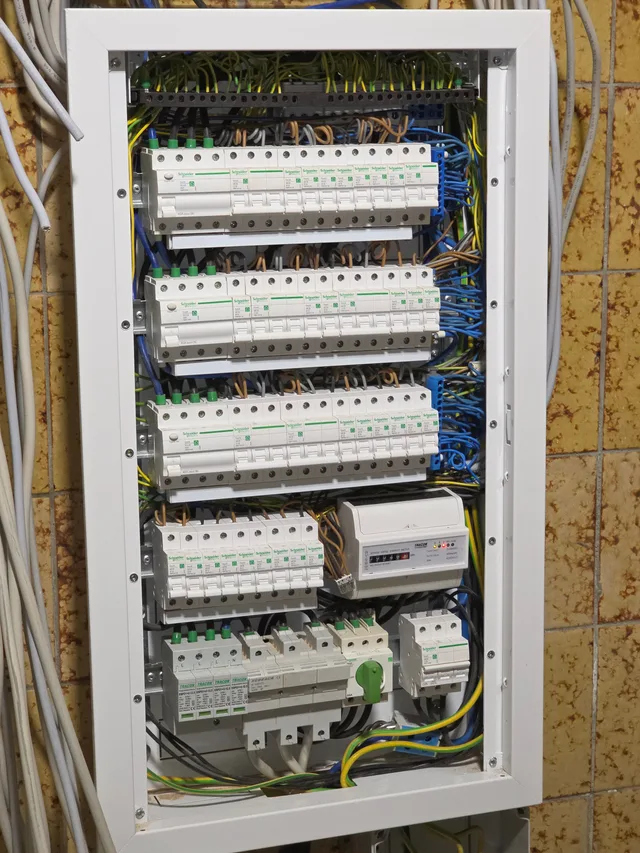
What is distribution board pre-assembly?
Pre-assembly means that the inside of the board — the rails, the protective devices, the terminal blocks, the internal wiring and the labelling — is completed in our workshop rather than on site. The board is built to the electrical layout: we work out the number of circuits in advance, specify the overcurrent protection and select the components.
We check the finished board in the workshop and then deliver it to site. There we fix it in place, connect the cables that have already been run, and carry out the on-site tests.
Why is it faster?
Only installation and connection are left on site
The most painstaking part of the job — the internal wiring, the rails, the labelling — is already done when the board arrives on site. For an average family home, installation and connection there can typically be completed within a day.
No waiting for other trades
Assembling a board on site needs a clean, dry, accessible room. On a building site that is rarely the case: people are plastering, sanding, painting. If the inside of the board is built in the workshop, the work doesn't depend on whether the room happens to be usable — on site, only a short window is needed for installation.
Everything to hand
In the workshop every tool, material and component is to hand. Nobody has to drive to the wholesaler for a missing terminal block, and the work doesn't stall next to a half-finished board.
Why is it safer?
Tidy conditions, fewer chances for error
Working precisely is harder in the dust, in poor light and in a cramped space. In the workshop the wires go in neatly, at even lengths, with properly tightened connections. A tidy board doesn't just look better: it is clearer, easier to check and safer to extend later.
Checked before installation
We go over the finished board while it is still in the workshop: is every circuit connected according to the design, are the labels right, have the right protective devices been chosen? If we find a fault, we fix it there — not on site in the days before the move-in.
Built to the standard
Distribution boards in residential buildings that ordinary people may operate are covered by the EN IEC 61439-3 standard (‘Distribution boards intended to be operated by ordinary persons’, or DBO for short). The standard applies to boards on which the occupants carry out simple operations — for example, switching a circuit breaker back on.
After connecting the board on site, we carry out an electrical safety inspection and hand over a test report.
Easier fault-finding years later
A distribution board shows how carefully it was built not on moving-in day, but years later. If a circuit breaker trips one day, or a circuit needs to be extended, tidy wiring, accurate labels and photo documentation save minutes of searching — and reduce the chance of someone switching off the wrong circuit or touching the wrong wire. A well-documented board also helps whoever works on it years later, even if they are not from our team.
What does our service include?
- Sizing: we work out the number of circuits and the overcurrent protection, and size the assembly to the load.
- Components: we work with parts from well-known, proven manufacturers.
- Assembly and labelling: every circuit is clearly marked, so the board stays easy to follow years from now.
- Checking and documentation: we produce photo documentation and labelling for every circuit, and after connecting the board on site we hand over an electrical safety inspection report.
How does the work run, step by step?
1. Design and coordination
Everything starts with the electrical layout. We look at how many circuits will be needed, which loads will be on which circuit, and whether there are any special requirements: a heat pump, an EV charger, solar panels, a pool, garden lighting or a smart home system. If there is no finished electrical layout yet, we do this step together with the design work.
2. Sizing and materials list
Based on the layout, we work out the number of circuits and the overcurrent protection, decide how the RCDs will be allocated, and whether surge protection and sub-meters are needed. From this we produce the materials list and the internal layout of the board: what goes on which rail, and how much spare space is left.
3. Assembly in the workshop
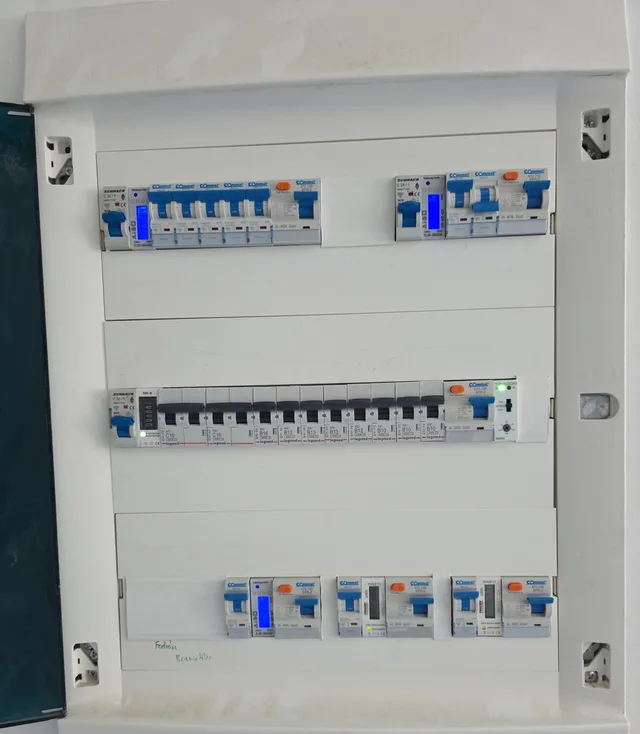
The board is built in the workshop to the internal layout: rails, protective devices, terminal blocks, internal wiring. We run the wires neatly along the rails so that the board stays easy to follow and to extend later on.
4. Labelling and documentation
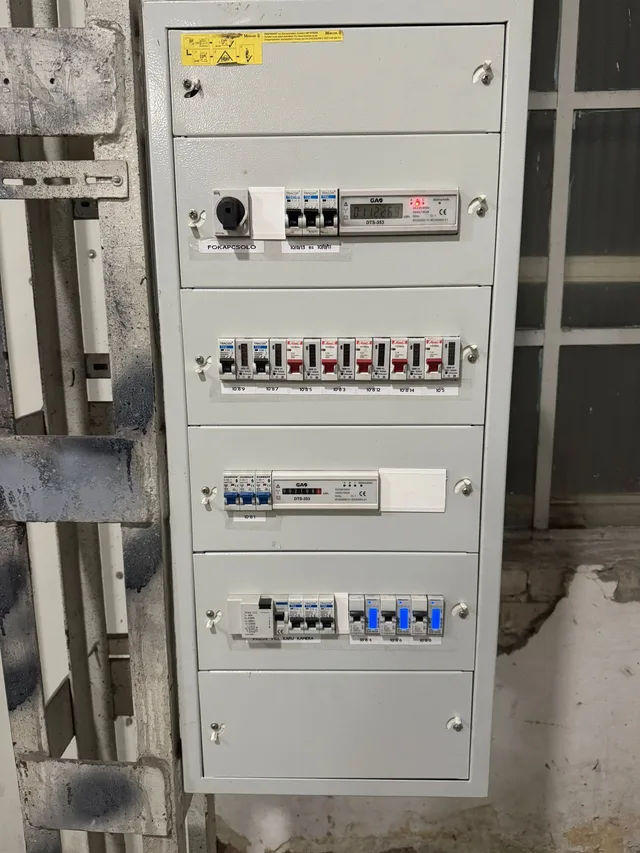
Every circuit gets a clear label, so that even years later it is obvious at a glance which circuit breaker protects which room or appliance. Photo documentation is made of the board and the circuits.
5. Installation and connection on site
We deliver the finished board to site, fix it in place and connect the cables that have already been run. As the inside is already built, this step is short and fits easily into the build programme.
6. Testing, inspection, handover
After connection we carry out the on-site tests and the electrical safety inspection, then hand over the test report and the documentation. The board is then ready for use — and if it needs extending later, the documentation tells us exactly where there is spare capacity.
Smart home ready
In a smart home, the distribution board holds not only protective devices but control modules too. We also pre-assemble boards for systems based on Loxone Miniserver, KNX or Shelly: the smart modules go on a separate DIN rail, so the board stays clear and the control side is kept apart from the protection side.
If the smart home is only coming later, we can still prepare the board for it: we leave enough space and spare capacity so that adding it won't mean buying a new board. We have written about how a Loxone system is put together in detail in our Loxone series.
For main contractors and partners
Pre-assembly is a great help for main contractors and prime contractors too, because it makes the electrical work more predictable in the build programme.
Short time on site
Because the inside of the board is built in the workshop, less time is needed on site. That is easier to fit into the sequence of trades and causes less disruption to the other teams.
Coordination from the design stage
We take on the plans in advance and agree the number of circuits, the protective devices and the space the board needs. That way the recess in the wall, the cable entries and the size of the board match from the start.
Documentation you can pass on
The photo documentation, the labelling and the electrical safety inspection report can also be used when handing over to the client, and they make maintenance easier later on.
One party responsible for the electrics
From design to handover, one team is responsible for the distribution board — there is no question of who fitted what and who tested what.
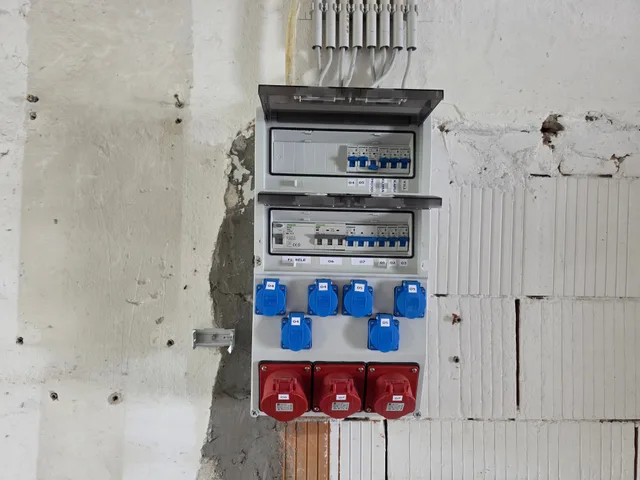
We work the same way on larger jobs — offices, shops, workshops; our portfolio also includes industrial-grade, IP-rated distribution boards.
What should you think about at the design stage?
Pre-assembly works best when the board's location and size are settled at the design stage. A few questions worth thinking through early:
- Where will the board go? Somewhere easily accessible, where it will still be comfortable to work on it years from now — not behind a built-in wardrobe or in a hard-to-reach corner.
- How big should it be? A smart home needs more space than a conventional house, and it is worth leaving spare capacity for future additions too. A board that is planned too small can later only be extended by replacing it.
- Where will the cables come in? The cable entries need to be prepared in the wall or the floor to suit the board's location.
- Which loads are worth metering separately? For a heat pump, an EV charger or a solar system, a sub-meter can be useful — and it takes up space in the board.
- Will there be a smart home, now or later? If so, the control modules need their own space.
We help with these questions during the on-site visit and the design process; you don't have to decide them on your own.
When is this not the right solution?
Pre-assembly pays off most in new builds, full renovations and board replacements. If only one or two circuits need adding to an existing board in good condition, or a circuit breaker needs replacing, we usually do that on site. If the existing board is outdated, we will tell you during the on-site visit when it is worth considering a full replacement.
Frequently asked questions
How much faster is it to install a workshop pre-assembled board?
The finished, labelled and checked board only needs connecting on site, which for an average family home is typically done within a day. We agree the exact time during the survey, depending on the size of the board and the site.
What components do you build the board from?
We work with components from reliable manufacturers. We size the exact configuration to the load and the number of circuits.
Can the board be prepared for a smart home?
Yes. For Loxone Miniserver, KNX or Shelly systems we integrate the smart modules on a separate DIN rail, so the board stays clear and can be extended later.
Do I get documentation of the finished board?
Yes. We produce photo documentation and labelling for every circuit, and after connecting the board on site we hand over an electrical safety inspection report.
How can we work together as a main contractor?
We take on the plans in advance, agree the schedule and the space requirements, pre-assemble the board in our workshop and install it on the date set in the build programme.
Building a new home, renovating, or looking for an electrical partner as a main contractor?
During a free on-site visit we go through your plans or your existing distribution board and show you which solution suits your project — in Sopron and within 30 km of it.
📞 +36 30 522 7954 ✉️ info@simplesmartelektro.hu Distribution board pre-assembly in Sopron → Electrical installation in Sopron → Meter box standardisation →