If you are planning a heat pump, a wallbox or solar PV in Sopron and within 30 km, bringing the meter point up to current standard will very likely be the first electrical task — before you buy or order anything. In many older family homes, the meter cabinet was built to standards from decades ago. If you want to have a new, larger load connected at such a cabinet, the meter point must first be brought up to the current standard.
The most important advice: before you buy or sign anything, request a free survey from us — on site, or based on photos and a description of your needs. We'll tell you whether your current meter point is suitable, whether it needs extending, and roughly what work is involved. We only talk about prices afterwards — every house is different.
This article is about older houses and flats. An on-site survey isn't always needed: in many cases we can already tell from photos and a short description of your needs whether an upgrade is required. If that's not enough, we decide together with a free on-site survey.
1. What is the meter point, and what does bringing it up to standard mean?
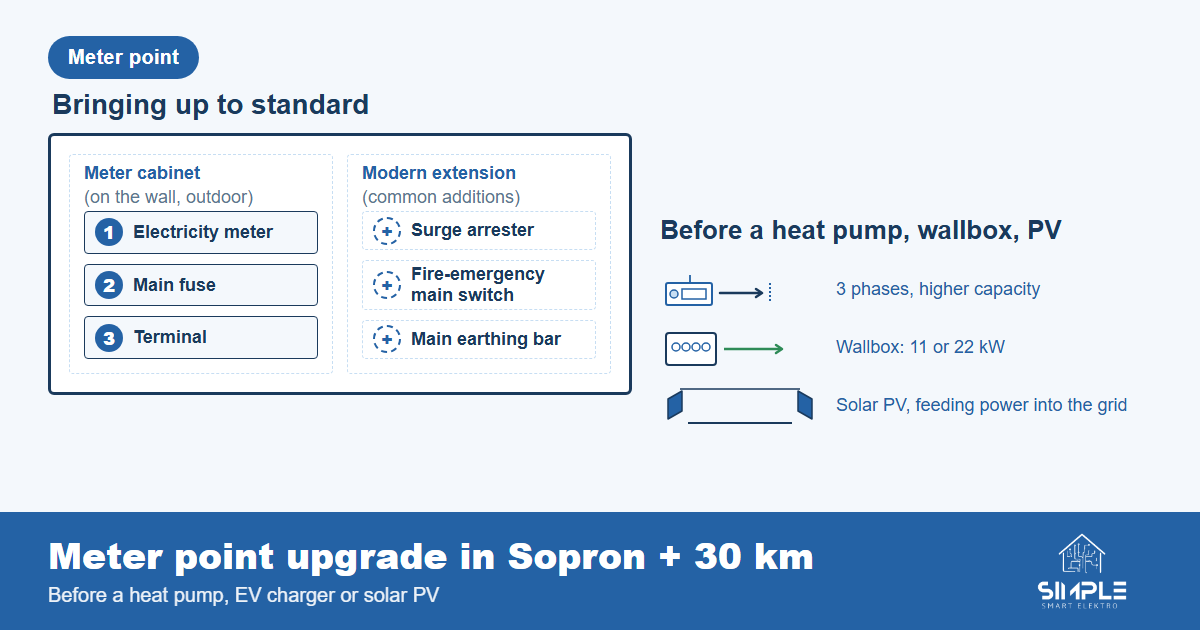
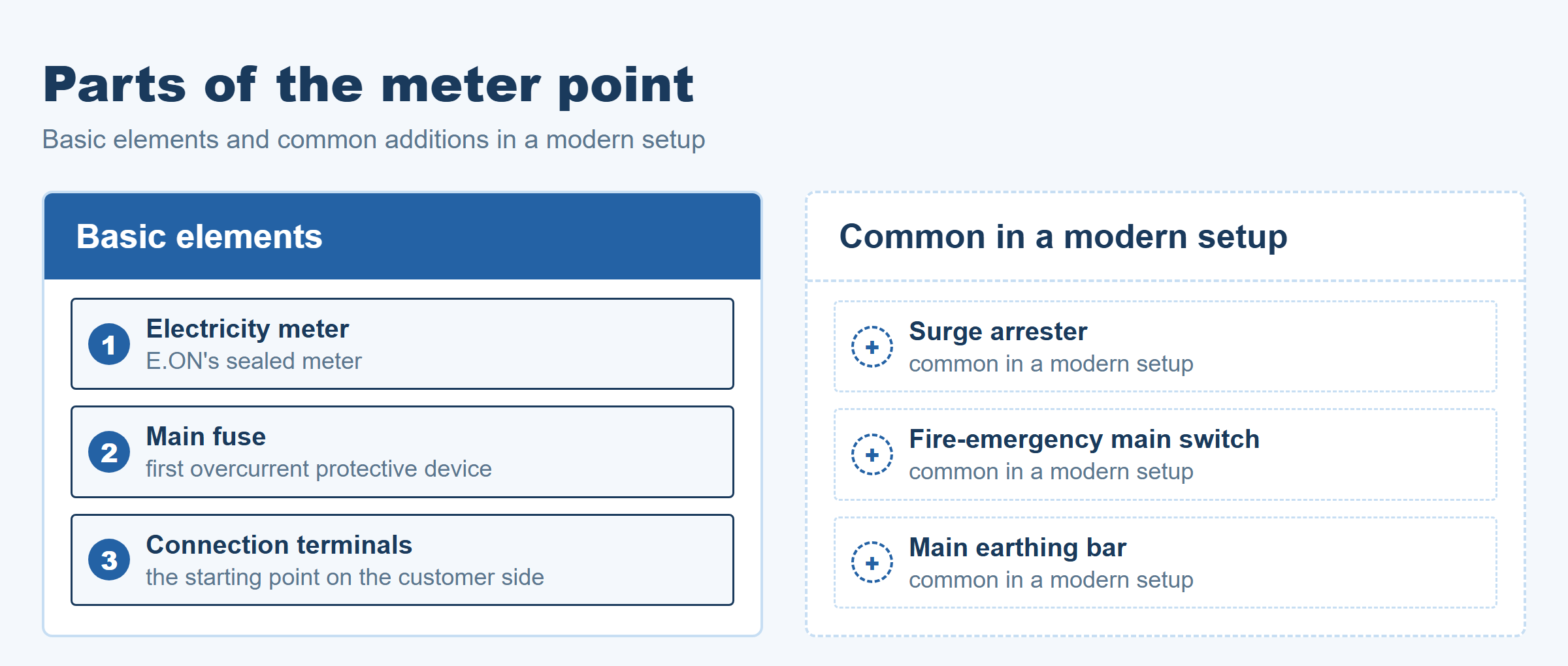
The meter point (in everyday language the meter cabinet) is the wall cabinet on the outside of the house — usually near the front door or in the garage — that contains the network operator's sealed electricity meter (in our region, E.ON), the first overcurrent protective device on the customer side (in everyday language the main fuse) and the connection terminals. In a modern setup you'll also often find a surge arrester, a fire-emergency main switch and a main earthing bar inside. This is where the house's internal electrical network starts.
Bringing it up to current standard is not the same as swapping the cabinet for a "nice new one". It's a technical and administrative process whose goal is to bring the meter point in line with the Hungarian standards currently in force and the network operator's requirements. In practice this most often means swapping the old, outdated cabinet, and we also modernise the internal wiring, the protective devices and the terminals — depending on what we find during the survey.
2. When does the topic come up?
Bringing the meter point up to standard isn't a voluntary renovation. It usually comes up because something is changing in the house and E.ON tells you the meter point isn't suitable for the new requirement. The most common cases:
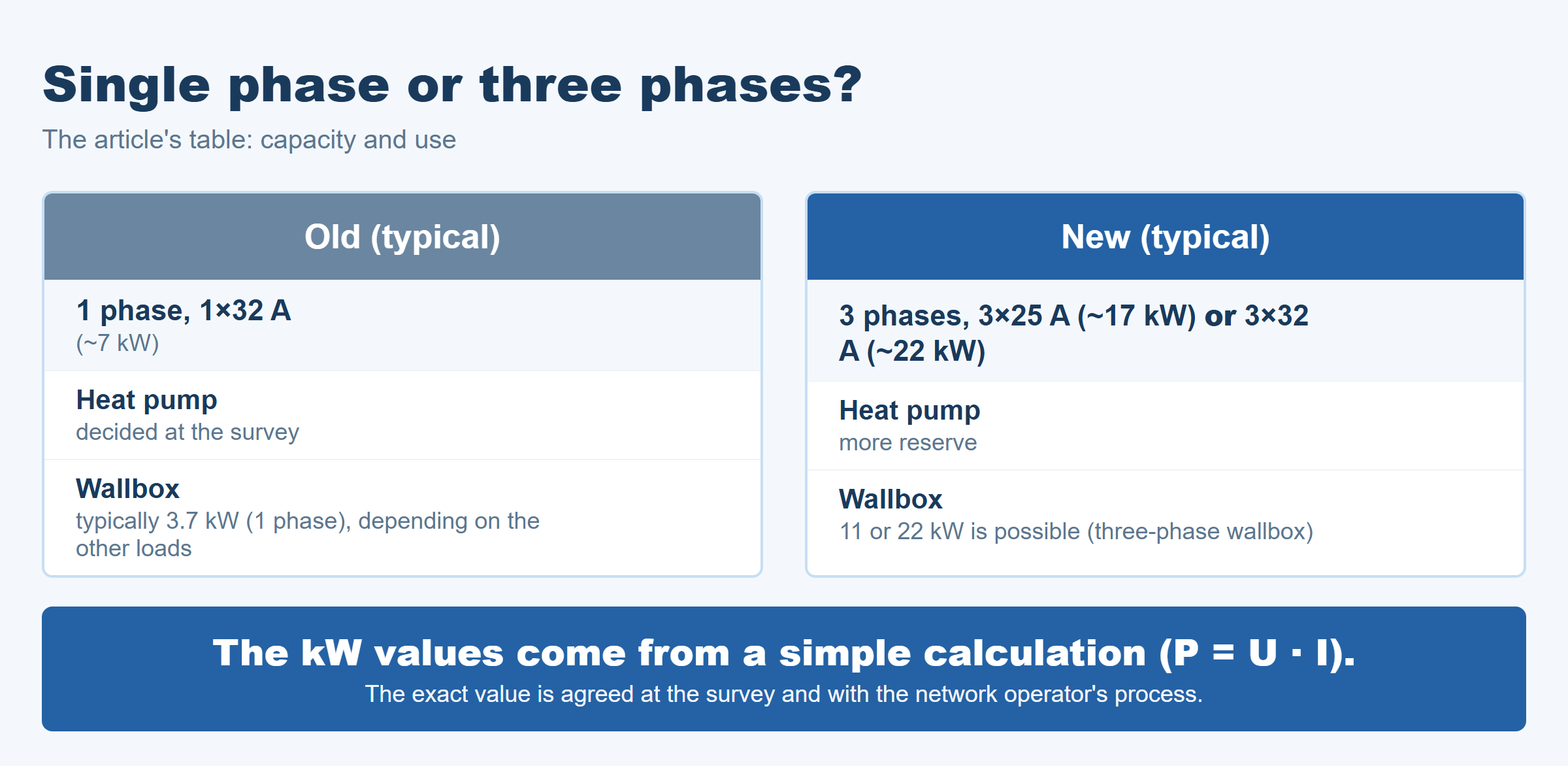
- Capacity upgrade (from single-phase to three-phase) — many older houses have a single-phase connection at 1×32 A (or smaller), which is roughly 7 kW of electrical capacity. If you want to add an EV charger, a heat pump, an air-conditioner or an electric cooker, you typically have to upgrade to three phases: 3×25 A (~17 kW) or 3×32 A (~22 kW). The network operator can only switch on the new capacity at a meter point that's up to standard.
- Before installing a heat pump — heat pumps often need a three-phase connection; the survey decides whether your house and appliance actually need it.
- Before installing a wallbox (EV charger) — a wallbox typically runs at 3.7–22 kW. A 3.7 kW charger (single phase, 16 A) still fits a 1×32 A house connection, but at 11 kW (3×16 A) or 22 kW (3×32 A) on a three-phase wallbox, the meter point must be suitable and may need extending.
- Replacing an old, outdated cabinet — if the cabinet is clearly old (cracked plastic, missing door, smell of burning, loose conductors), it should be put in order regardless of any upcoming major investment. A cabinet that hasn't been touched in decades is worth having looked at.
3. From single-phase to three-phase — why and what's affected?
The difference between a single-phase (230 V) and a three-phase (3×230 V, in practice 400 V) connection is often seen by non-experts as just "more power" — but it's not only about capacity: with a three-phase connection, larger loads can be spread across the phases.
| Old (typical) | New (typical) |
|---|---|
| 1 phase, 1×32 A (~7 kW) | 3 phases, 3×25 A (~17 kW) or 3×32 A (~22 kW) |
| Heat pump: the survey decides if it's enough | Heat pump: more headroom |
| EV charger: typically 3.7 kW (single phase), depending on other loads | EV charger: 11 or 22 kW possible (3-phase wallbox) |
The kW values come from a simple calculation (P = U · I): 1×32 A is about 7 kW, 3×25 A is about 17 kW, 3×32 A is about 22 kW. We confirm the exact value at the survey and during the network operator's procedure.
What happens during the upgrade?
Upgrading to three phases isn't just "flipping a switch" — we always carry out the work together with bringing the meter point up to standard. The survey decides what's needed: replacing the main cable and inspecting the distribution board are only necessary if the existing ones don't comply — in many houses they don't need to. We also balance the phases in the internal network, perform a touch-protection (earthing/safety) inspection, and hand over the acceptance documentation to E.ON. If you're also planning solar PV, it's definitely worth discussing that before installation — ideally in a joint consultation with the PV installer.
H tariff (Hungarian heat-pump tariff) — a brief overview
The H tariff (heat-pump preferential tariff) is a seasonal, preferential residential tariff intended for heating purposes that can only be applied for with a heating system based on heat-pump technology or renewable energy. The idea is that you get the electricity the heat pump uses at a preferential rate, with the supply measured on its own separately metered circuit running through a dedicated two-rate meter.
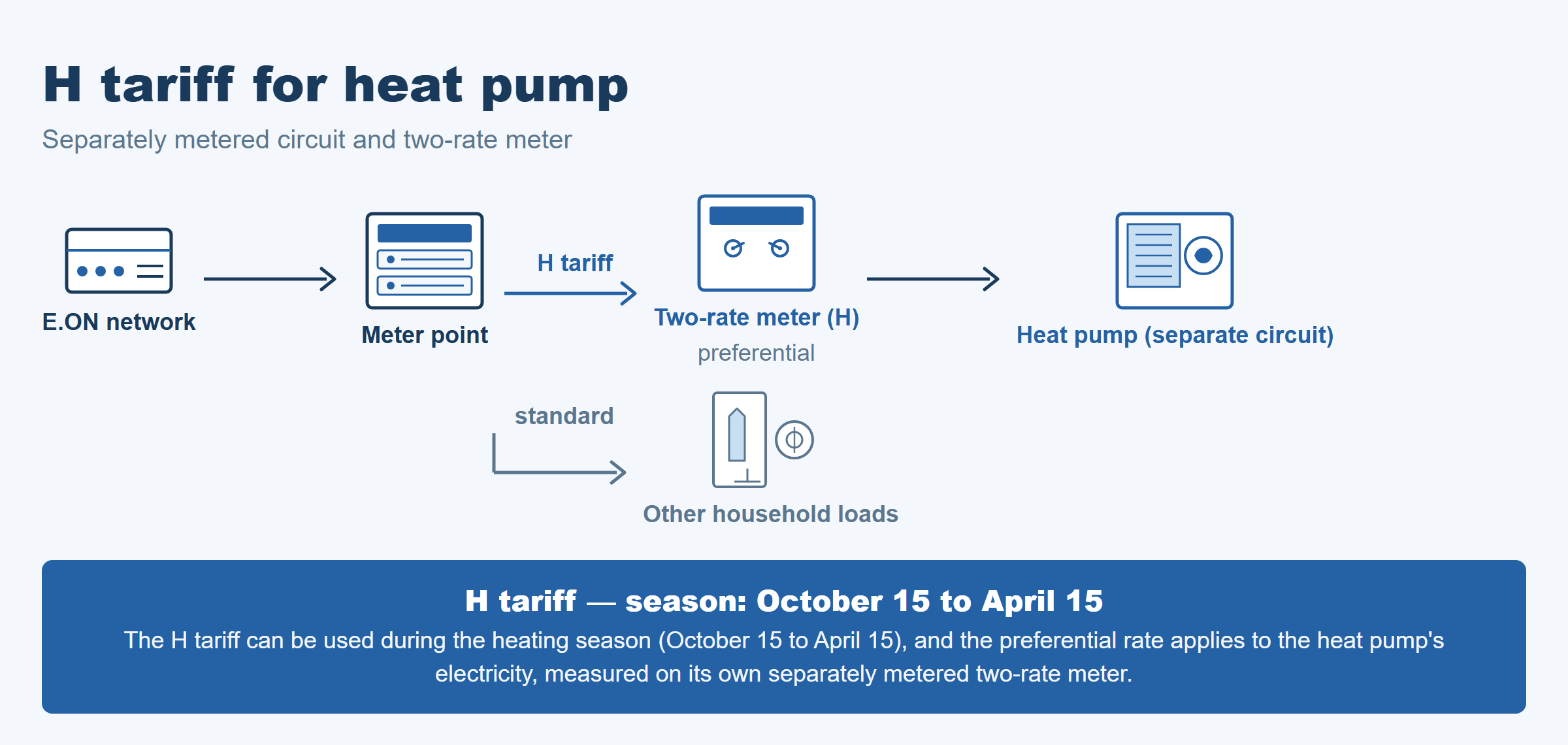
A precondition for the H tariff is that the meter point is suitable for setting up a separately metered circuit — in practice this often goes hand in hand with bringing the meter point up to standard and the capacity upgrade. To apply, you need the heat pump's data sheet, and the exact conditions and administration are agreed with the distribution network operator — we'll go through all of this with you at the survey.
Earthing and the protective conductor — why this matters too
Many older houses lack a protective earth / protective conductor that meets today's standard, or the existing one doesn't follow the current rules. This is a safety risk: without a protective conductor, the metal housing of an appliance can reach a dangerous voltage in the event of a fault.
Decree 40/2017. (XII. 4.) NGM requires that, when the user-side installation is modified or renovated, the contractor's responsible technical lead must issue a declaration of conformity and carry out a touch-protection (earthing/safety) inspection. So if the protective conductor is missing or inadequate, it must be added together with the meter-point upgrade. We can check this at the survey and include it in the offer.
4. The process step by step
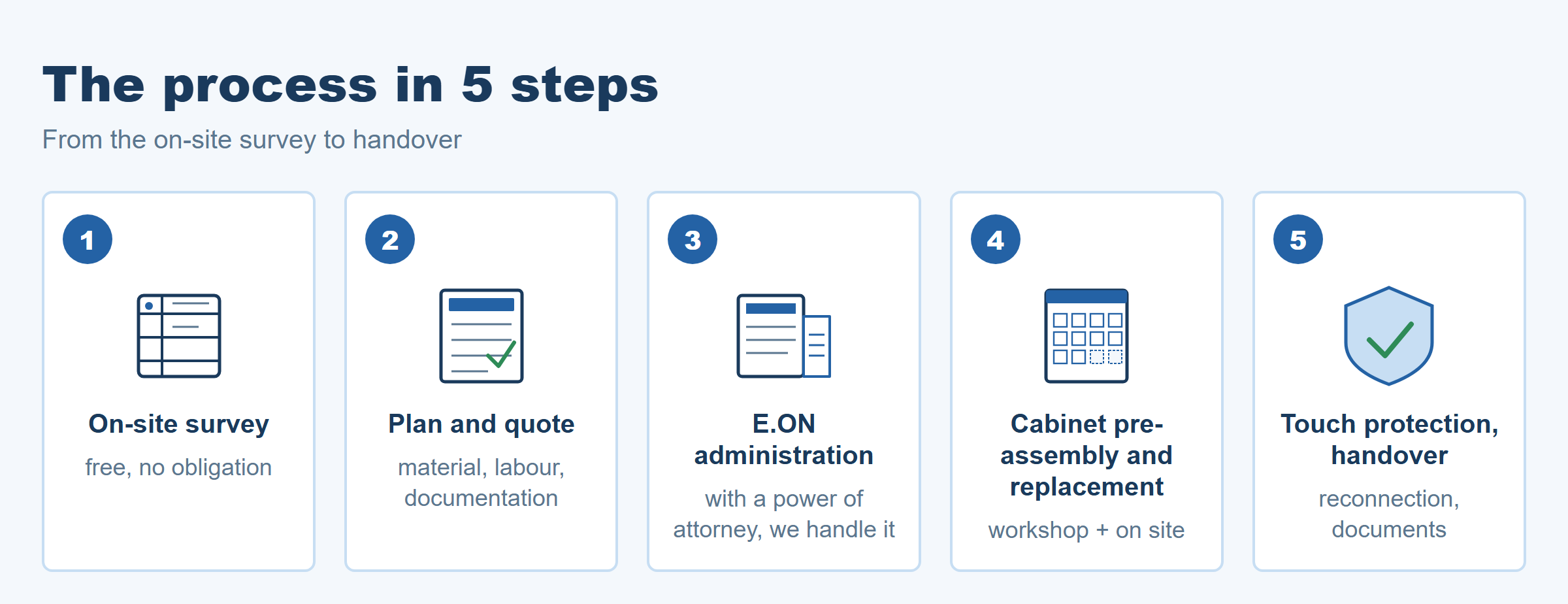
In a Sopron family home, the upgrade and capacity increase follow these steps — so you roughly know what to expect:
- On-site survey — we visit, inspect the existing meter point and the house's internal electrical network: condition of the wiring, distribution board, main cable, list of loads. It's free and there's no commitment.
- Plan and quote — based on the survey we give you a written quote: which materials, which work steps, which documentation. We only talk about prices here — before the survey we can't give you a range or a fixed figure, because every house is different.
- E.ON administration with a power of attorney — we handle all the administration with E.ON: plan submission, coordination, documentation. We prepare the power-of-attorney template — you just sign.
- Cabinet pre-assembly in the workshop + on-site swap — we pre-assemble the new cabinet in our workshop and swap it over on site. We agree the exact schedule after the survey and the E.ON coordination; the network operator's scheduling also affects this.
- Touch-protection inspection, handover and documentation — on the new meter point we carry out the touch-protection inspection, hand over the acceptance report and the cabinet documentation to E.ON, and the operator reconnects the network at the new capacity. All documents stay with you.
What should you prepare? — Checklist
To keep the survey and the work smooth, it's worth gathering the following beforehand:
- Your E.ON contract or latest bill — this shows the current connection value (1×32 A, 3×25 A etc.) and your consumption history.
- A list of the new loads you plan — heat pump (brand, model, output), EV charger (single-phase / three-phase, kW), air-conditioner, electric cooker. Without these we can't size the new cabinet accurately.
- Location of the meter and condition of the cabinet — phone photos are fine if you'd like to send them ahead of the survey.
- Access to the meter point — for vacant plots, tenants etc., arrange access in advance.
5. Frequently asked questions
What if I install an EV charger without bringing the meter point up to standard?
At a non-standard meter point the network operator can't switch on the increased capacity, so the charger can't run at its planned output. It's worth getting the upgrade sorted before installing the charger.
Is the H tariff always needed for a heat pump?
Not mandatory, but worth considering: the H tariff can be used in the heating season (15 October – 15 April), and the preferential price applies to the heat pump's separately metered, two-rate-meter supply. At the survey we'll discuss whether this makes sense for your meter point and your heat pump.
What if the house turns out to have no earthing?
Then the protective conductor and the touch-protection are part of the upgrade — it's the prerequisite for safe operation. We check this at the survey and include it in the offer together.
How much does the meter-point upgrade cost?
There is no standard price — it depends on the condition of the existing cabinet, the internal network, whether earthing needs to be added, and on the house itself. At the free on-site survey we can give concrete answers to all of these questions.
Request a free survey in Sopron
If you're planning a heat pump, an EV charger or solar PV in Sopron or within 30 km, the first step isn't ordering the equipment, but a free survey (on site, or based on photos and a description of your needs). We'll tell you what state the meter point is currently in, whether it needs upgrading or extending, and roughly what work to expect. We only talk about prices after that — every house is different.
How to request a survey:
- 📞 Call: +36 30 522 7954
- ✉️ Email: info@simplesmartelektro.hu
- 🌐 Website: www.simplesmartelektro.hu/en/merohely-szabvanyositas-sopron/
The survey is free and without commitment, and we'll call you back within 24 hours. We work in Sopron and within 30 km — if you live outside this area, write or call, and we'll tell you whether we can help. We also travel further out, but there we charge a call-out fee that is deducted from the accepted quote.
In short: bringing the meter point up to standard isn't a scary procedure — it's a well-documented, step-by-step process. The result: a meter point that meets today's standards and can support a heat pump, an EV charger or solar PV.
Request a free survey
In Sopron and within 30 km the on-site survey is free and without obligation. We'll tell you whether an upgrade is needed and roughly what work is involved.
📞 +36 30 522 7954 ✉️ info@simplesmartelektro.hu Meter point upgrade — service page → How an electrician's quote is put together →